 >
>
How to Access Kibale National Park Uganda
Getting to Kibale Forest National Park Uganda – How to Access Kibale national park
| From | To Kibale National Park |
| Kampala via Fort Portal | 330km |
| Fort Portal | 30km |
| Murchison Falls National Park (MFNP) | 441km |
| Bwindi Impenetrable National Park | |
| Buhoma | 280km |
| Nkuringo | 436km |
| Rushaga | 429km |
| Ruhija | 338km |
| Queen Elizabeth National Park | |
| Ishasha | 217km |
| Mweya | 157km |
| Kabale | 384km |
| Kisoro | 464km |
| Mbarara | 154km |
There a daily public bus services between Kampala and Kibale National Park. Although the roads are relatively fine, tourists are still advised to use FWD power vehicles to reach the park (if they prefer to use private means).
By Air; Tourists can book one of the flights from either Entebbe International Airport or Kajjansi Airfield to the Airstrips in western Uganda. There is an airstrip in the Tooro-Semuliki Wildlife reserve which is 86km by road from Kanyanchu in Kibale National Park. Another airfield is in Kasese, just 75km from Fort Portal Town. Tourists can also fly to the Nyakisharara airstrip in Mbarara.
Tourist Attractions in Kibale Forest National Park Uganda
 Primate Species, Kibale National Park is deserves the tagline “primate planet” a major reason why tourists should direct their safaris to this life-filled destination. The park has thirteen (13) species of primates including the vervet monkeys, the black and white colobus monkeys, L’Hoest’s monkey, grey cheeked Mangabey, the threatened red colobus monkey, blue monkeys, the red tailed monkeys, and the olive baboons. Adding to these, tourists can also see a number of night-time primates like the bush babies and the pottos. Kibale has an insurmountable 1,450 chimpanzees which if combined with the other primates make Kibale one of Africa’s most populated and diverse primate destination.
 Other wildlife species, The park is known more for its primate population, a reason it has gained itself the tagline “primate planet”, but it is not limited to primates alone. There are a number of ground dwelling mammal species in Kibale National Park including some which migrate between Kibale and Queen Elizabeth and others which have a permanent home in Kibale. The park has a number of hippopotamuses, an estimated 500 forest elephants, the marsh mongooses, Alexander’s Cusimanse, the Golden Cat, bush pigs, African Palm Civet, leopards, lions, Ichneumon, Harvey’s and Peter’s duikers, buffalos, Serval cat, Ratel (Honey Badger), the giant hog and a number of bush pigs. Other mammals can be seen in the swamps like the swamp otter. Just outside the park tourists can see the Sitatunga in the adjacent Bigodi wetland. The park is not limited to reptiles and amphibians; these can be seen along the trails and around the wetlands.
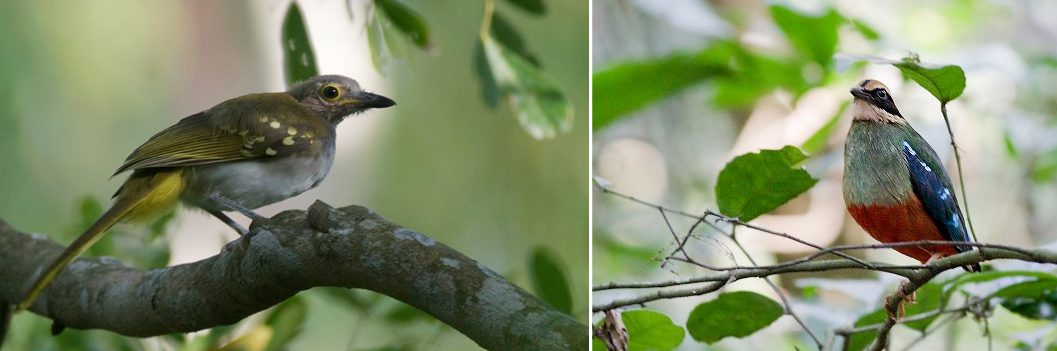 Bird and Butterfly Species, Kibale National Park has a long list of bird species and these include the Afep Pigeon, White-naped Pigeon, Brown-chested Alethe, Little Green Bul, Abyssinian Ground-thrush, Yellow-rumped Tinkerbird, Red-chested Owlet, Green-breasted Pitta, the Yellow Spotted Nicator, Brown Illadopsis, White-tailed Ant-thrush, Collared Apalis, Warbler Scaly-breasted Illadopsis , the Crowned Eagle, Black Bee-eater, Little Greenbul, Black-capped Apalis, Dusky Crimsonwing, Nahans francolin, White-naped Pigeon, Red-chested fluff tail, Blue-headed Sunbird and the Blue-breasted Kingfisher. These are just a piece of the 375 individually unique bird species which can be found in this park. Tourists also have an opportunity to see and take pictures of a number of colorful bird species. So far 250 butterfly species have been identified.

Floral Species, At the time when Kibale was still managed as a forest reserve, many of her tree species were logged, resulting into the extinction of a great number of plant and tree species. However over the years, there have been campaigns to carry out reforestation in order to revive some of those unique tree species. Furthermore, a number of exotic tree species like the beautiful pine trees and eucalyptus have also been introduced in the park’s forest. Today the park boasts of over 250 tree species, with the largest part of the park being covered by a moist evergreen semi-deciduous forest. These tree species continue to attract tourists and researchers who are interested in botany.

Ndali – Kasenda crater lakes, This is a spot for everyone to visit. The Ndali – Kasenda crater lakes are situated about 30km south of Fort Portal town. This area forms a stretch of 60 stable and seasonal freshwater lakes which are in the areas of Rweetera, Kasenda, Kabata and Rwaihamba. The lakes at Kasenda are famous for their magical history. The local people narrate that after losing his throne to Wamala his son; the ruler of the Bachwezi called Ndahura, left his kingdom and formed the lakes we see today at Kasenda. But it is not only for their history that they are worthy visiting but also the beauty that they present especially in the vegetation that surrounds them. At this point tourists can see colorful butteries, the harmonious bird species, and the jubilant monkeys. The place offers awesome views of the expansive tea estates of Kabarole district, the beautiful snowcapped Rwenzori Mountains; and to the south tourists can see Lake George and the Rift Valley plains.
Tourist Activities in Kibale Forest National Park Uganda
 Chimpanzee tracking/trekking and habituation,It is profoundly easy to see the chimpanzees of Kibale National Park, and these dominate the animals which are sighted when in the Kanyanchu walk. The starting times for the Kanyancu walk are 7am and 2pm lasting about three (3) hours on average; exposing life in varied forms along the way. Tourists who wish to see the chimps doing their private obligations like copulation, breast feeding, resting patrolling and exhibiting; have to get up earlier to view the chimps between 6:00 and 6:30am until the time the chimps build their new nests at around 7:00pm. There is also an opportunity for tourists to take part in the Chimpanzee habituation experience (CHEX) which takes a full day. The tourists will be assigned to chimpanzee communities which are under habituation and this is such a rewarding experience to explore the cleverness of these animals. Prior booking is however recommended for those who wish to participate in this activity.
Nature walks and hiking in Kibale National Park, The day nature walk is surely something to look out for, as it will unveil a number of flora and fauna species. Since the walks are done through the jungle, it is advisable that tourists travel with a ranger guide for their security but also for easier identification of species. Tourists who wish to add to their list of sightings can decide to embark on a guided night nature walk where they will stand a chance of seeing nocturnal animals like the bush babies, hyraxes, nightjar, crickets’ pottos and the rarely seen serval cat. This is facilitated by the use of bright shining flashlights.
Birding in Kibale National Park, Kibale National Park has up to 138 bird species which may be seen during the guided nature walks along the viewing platforms and the boardwalk trail. This abundance of bird species ensures that birders find this to be their own haven where they can see species like the White-breasted Negrofinch, Hairy-breasted Barbet, Yellow-spotted Barbet, Black Bishop, the Grey-winged Robin-chat and the Western Nicator. The birding tour starts from a place called Kanyanchu at 7:00am. Birders can find more bird species just outside the park at a place called the Bigodi Wetland Sanctuary.
Cultural encounters, Tourists also have the opportunity to meet with the Batooro and the Bakiga who are the Park’s main neighbors. While with these people tourists can enjoy learning a great deal about how these people do their daily work in a traditional way including the making and selling of crafts, traditional healing, music dance and drama and furthermore to just be immersed in the traditional lives of the Batooro and the Bakiga. This walk will take tourists to the Bigodi community where the local communities have grouped themselves under the KAFRED umbrella (Kibale Association for Rural Environment Development). This ecotourism establishment has greatly supported the livelihoods of these people through direct and indirect benefits from tourism.
Safari lodges in Kibale Forest National Park Uganda
Primate Lodge Kibale

The lodge is hidden deep into Kibale National Park and provides a real feel of the true African jungle. This is the best way to sleep when oj a primate tracking safari to Kibale National Park. Guest accommodations include eight (8) superior safari tents; seven (7) ultimate forest cottages; a remote sky tree house and an expansive and well maintained camping area. All accommodations apart from the camping area have en-suite washroom facilities while those who use the camping area have lavatories which they can all share. The main lodge are has power spots from where clients can charge their gadgets, a bar and restaurant, gift shops and ample parking area. While at the lodge, guests can enjoy performances done by traditional dance groups and can also enjoy the music made by the parks birds and primates. Guests are expected to check-in at 2:00pm and checkout at 10:00am.
Find More about Safari Lodges Kibale Forest National Park Uganda

Over 300 excellent reviews on TripAdvisor
Over 50 excellent reviews on Safaribookings.
Over 50 excellent reviews on Safaribookings.
12+ years of experience.
Best price guarantee.

Robert
Get in touch with a travel expert to plan your gorilla tours and wildlife safaris...
Obtain professional travel guidance by either calling us or arranging a video conference with our experts.