 >
> 
THE BEST NATIONAL PARKS IN CONGO, CONGO NATIONAL PARKS
Explore the best National Parks in Congo, where Central Africa's untouched rainforests, active volcanoes, and incredible wildlife offer unforgettable safari experiences.
The Democratic Republic of the Congo (DRC) and the Republic of the Congo (ROC) are home to some of Africa's most biodiverse ecosystems worth discovering during Congo safaris.
From rare mountain and eastern lowland gorillas to forest elephants and African golden cats, Congo National Parks protect rare species and natural resources vital to global conservation.
This is a detailed breakdown of the Congo national parks worth exploring on Congo wildlife safaris!


Examples of National Parks in Congo | What is the Name of the Safari Park in the Congo?
Congo is home to over a dozen wildlife safari parks in both the DRC and ROC. These protected areas include:
1) IN THE DEMOCRATIC REPUBLIC OF CONGO
| Virunga National Park | Kahuzi-Biega NP | Garamba National Park |
| Salonga National Park | Maiko National Park | Lomami National Park |
| Mangroves National Park | Upemba National Park | Kundelungu National Park |
2) IN THE REPUBLIC OF THE CONGO
| Odzala-Kokoua National Park | Nouabalé-Ndoki National Park |
| Conkouati-Douli NaP | Ntokou-Pikounda NP |
| Ogooué-Leketi NP | |
These wildlife safari parks form a crucial part of the Congo Basin, a region renowned for its rich biodiversity and ecological significance, hosting over 3,000 faunal and floral species, with many endemic to the Albertine Rift.
DRC Safari Parks
With the Central African Republic and South Sudan to the north; Uganda, Rwanda, Burundi, and Tanzania (through Lake Tanganyika) to the east; the Republic of the Congo to the west (with a complicated 1,775 km border that includes land and river sections); and Zambia and Angola (including Cabinda) to the south, the Democratic Republic of Congo (DRC) is a part of the larger Congo Republic.
This is the only country with all types of gorillas, e.g., western & eastern lowlands, plus mountain gorillas; many endemic species, including the Congo Peafowl and the Bonobo, and one of the most visited countries in Africa for gorilla tours.
The wildlife safari parks located in the northern and eastern Congo (Democratic Republic of Congo), which is one of the most popular destinations in the eastern part of the country, after South Sudan and the Central African Republic in the north, include.
Formerly Known as Albert National Park, Virunga National Park

Africa’s oldest national park, Virunga (formerly Albert National Park), is a UNESCO Heritage Site and IUCN Category II park located in eastern DRC and is one of the best and most visited safari parks in DR Congo for remarkable safaris.
Gazetted by the Belgians in 1925 making it the oldest national park in Africa, it spans over 8,090 km², covering parts of the Albertine Rift, including Lake Edward in the southern sector, Lake Kivu’s northern shore, the Semuliki basin in the northern sector, and two active volcanoes: Mount Nyiragongo and Mount Nyamuragira.
It shares borders with the larger Virunga Conservation Area, which is shared with Volcanoes NP in Rwanda and Mgahinga NP in Uganda, and is home to three volcanoes (Virungas), namely Mikeno, Nyamuragira, and Nyiragongo.
Virunga Park is the home of the Mountain gorillas and golden monkeys in Congo, worth seeing on Congo gorilla tours
| Virunga Park Attractions | More than 706 bird species (including endemics of the Albertine Rift like the Regal Sunbird, Rwenzori Turaco, and Kivu Ground Thrush), two active Virunga volcanoes (Mount Nyiragongo, Africa’s most active volcano), Lake Edward, and other primates.
Plus, wildlife (Mountain gorillas, Chimpanzees, forest elephants, bush buffalo, okapis, forest hogs, leopards, hippos, and Nile crocodiles) and a variety of landscapes (bamboo forests, lava plains, and alpine meadows) are among the most sought-after attractions.
|
| Virunga Park Safari Activities | Mountain gorilla trekking, birdwatching, Nyamuragira mountain climbing and Nyiragongo active volcano hiking, nature conservation tours, and nature walks to see the surrounding Pygmy local communities. |
| Virunga Park Accommodation
| Kibumba Tented Camp, Mikeno Lodge, Bukima Camp. |
| Best Time to Visit Virunga Park | June–September and January (dry seasons), which are best for game viewing and gorilla trekking tours in Congo.
|
| Getting There | Flights to Goma or crossing from Rwanda (Gisenyi).
|
| Threats to Virunga Park
| Rebel groups, poaching, oil prospecting, several deadly attacks, and bush meat trade. Rangers in Virunga NP are often killed during confrontations with militias and local people communities |
Experience an incredible Congo safari by traveling to the most frequented and most-liked safari park, the Virunga!
Kahuzi-Biega National Park (Well-Known Eastern Lowland Gorilla Habitat Worldwide)
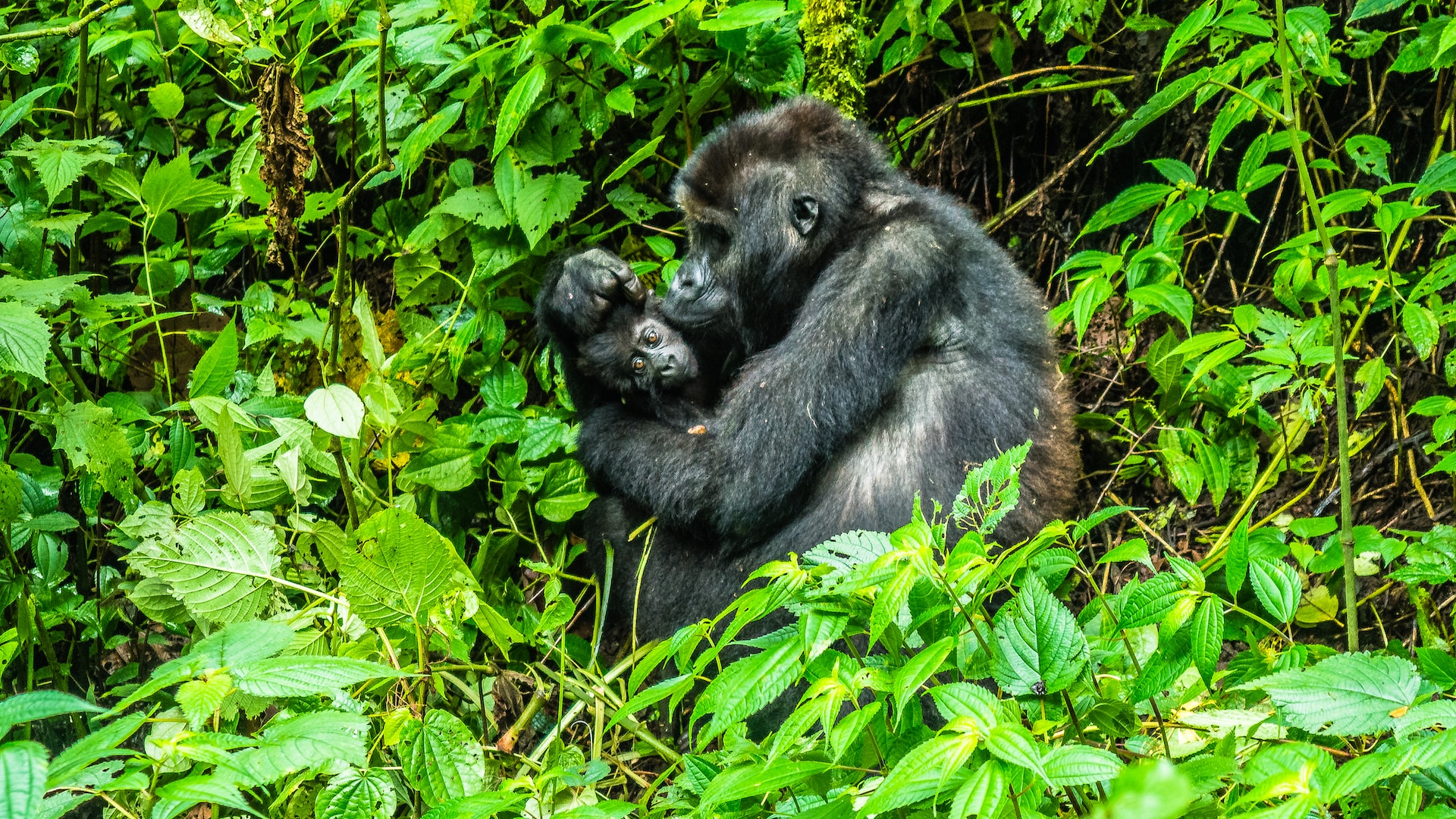
Kahuzi-Biega NP, which covers an area of more than 6,000 km² in the eastern Democratic Republic of the Congo, is home to the sole habitat of the largest of the four subspecies of gorillas on Earth, the eastern lowland gorilla (Gorilla beringei graueri), worth seeing during Congo gorilla safaris.
Established by Adrien Deschryver in 1970, this World Heritage Site (UNESCO) is a standout among Congo national parks and is named after Mount Kahuzi and Mount Biega.
It is situated near Bukavu on the western bank of Lake Kivu and includes Congo River Basin marshes, bamboo forests, and the lowland rain forest, hosting many unique species, including various mammal species and primates, including buffalo and forest elephants.
| Kahuzi-Biega Attractions
| Various Mammals & Primate including the eastern lowland gorillas (Grauer’s Gorillas), monkey species (Owl-faced monkeys, red-tailed monkeys, and others), rare wildlife species (forest elephants, bush buffalo, golden cats, chimpanzees, and giant alexander bush squirrels), etc.
Additionally, more than 349 bird species, and the Lwiro Chimpanzee sanctuary (a preeminent chimpanzee conservation sanctuary) are among the rare attractions that visitors can see during Congo safaris in Kahuzi-Biega
|
| Kahuzi-Biega Safari Activities | Lowland gorilla trekking, chimpanzee trekking, hiking on volcanoes, bird watching, cultural experiences, and guided nature walks are among the safari activities that visitors to Kahuzi-Biega National Park enjoy.
|
| Kahuzi Biega Accommodation | L’Orchids Safari Club, Mount Kahuzi Hotel, Coco Lodge.
|
| Best Time to Visit Kahuzi-Biega NP | Because the paths are drier during the dry seasons, which are June–October and December–February, these are the ideal times to visit Kahuzi Biega National Park.
|
| Getting There | Via Bukavu or Kamembe Airport (Rwanda).
|
In the safari park network of Central Africa, this park is a hidden jewel that is perfect for ecotourism and vacation with a conservation focus.
To travel and experience this well-known safari park in Congo, reserve a safari in Congo’s Kahuzi-Biega National Park right away!
Garamba National Park (One of the DR Congo’s UNESCO World Heritage Sites)
One of Africa’s oldest national parks, Garamba National Park was gazetted in 1938 and is located in the northern sector/north-eastern region of the Democratic Republic of the Congo, close to South Sudan and the Central African Republic in the north.
Garamba, which has more than 5,200 km² of land area and includes savanna grasslands, woodlands, rivers, and tropical forests, has been a UNESCO Heritage Site since 1980.
| Garamba Tourist Attractions | Kordofan giraffes, okapis (endemic Congolese giraffes), African forest and bush elephants, forest hogs, olive baboons, and more than 550 bird species are among the rare species that Garamba safeguards. The park, which was once home to the now critically endangered northern white rhinoceros, is now home to lions, chimpanzees, leopards, hippos, and forest buffalo, among other wildlife safari attractions seen during Congo wildlife tours.
|
| Garamba Safari Activities | Birdwatching, game drives, wildlife viewing, fishing, boat excursions, and nature walks are among the most popular activities for tourists visiting Garamba during a safari in Congo.
|
| Garamba NP Lodges & Hotels | Garamba Lodge and simple ranger camps. |
| Best Time to Visit Garamba | With drier paths and more active animals, the dry months of December through March and June through July are the best times to visit Garamba National Park. |
| Getting There | Road or charter flights via Isiro or Dungu.
|
Park rangers monitor Garamba, and the park management is led by the African Parks and ICCN (The International Union for Conservation of Nature) after having lost much of its wildlife due to poaching during the conflicts in Congo in the 1980s and 1990s.
The Congo National Parks system in the Central part of Africa still relies heavily on Garamba as a conservation hub, which has been supported and rehabilitated over several years by International wildlife organizations.
Explore Garamba, one of Congo’s top national parks, for a safari experience that will never be forgotten!
Maiko National Park (All DR Congo’s Endemic Species Habitat)
One of the most remote and unspoiled safari parks in the central part of Africa is Maiko National Park, which spans the provinces of Tshopo, Nord-Kivu (North Kivu), Orientale, and Maniema in the northeastern Democratic Republic of the Congo.
This remote park, previously a private hunting reserve or private hunting ground, spans more than 10,885 km² and is underdeveloped because of isolation and conflict, but even so, it still safeguards a sizable portion of the Congo rainforest that is alive with species.
| Maiko NP’s Attractions | Once a private hunting reserve or hunting ground, Maiko is now the only park in the world that is home to all three of the endemic Congo species—the Congo peafowl, okapi, and eastern lowland gorilla—all of which are worth viewing on wildlife trips in the country. Other animals (African forest elephants, golden cats, huge aquatic genets, leopards, and chimpanzees), hundreds of different bird species (such as the Congo peacock), and local community ethnic groups or cultural zones are additional attractions. |
| Maiko NP Safari Activities | Maiko has promise for ecotourism, wildlife research, and conservation tourism, despite the fact that tourism is restricted by its isolation and instability from rebel groups. Maiko supports a variety of activities, such as guided excursions, game viewing, and bird watching. |
| Maiko NP Lodging | Camping with the Congolese Institute for the Conservation of Nature (ICCN) permission.
|
| Best Time to Visit Maiko NP | December through February and June through August are the best times to visit during the dry seasons.
|
| Getting There | Access is challenging, primarily by foot or by air (chartered flights). |
Among Congo’s national parks, Maiko National Park is a little-known gem that protects endangered species in an unspoiled environment, though it experiences serious threats from armed groups and illegal mining, as well as minimal conservation infrastructure due to its remote location.
Nonetheless, there is a rising effort to preserve its rich biodiversity and deep rainforests, making it an important conservation area.
For incredible experiences, reserve your safari trips to Maiko, one of Congo’s top safari parks!
The Famous Salonga National Park (The Largest Rainforest Reserve in Africa and A UNESCO World Heritage Site)
The largest tropical rainforest national park in Africa, Salonga NP, is situated in the center of the Democratic Republic of the Congo, deep within the Congo River Basin.
Located in the Congo Rainforest Basin and spanning more than 36,000 km², Salonga was created in 1956 and designated a UNESCO World Heritage Site in 1984. It is only reachable by plane and the River Congo.
It is one of the most biodiverse regions on the African continent, with a topography dominated by marshes, woods, luxuriant rainforest, and sporadic meadows, making it one of the best birding spots in the DR Congo.
| Salonga Tourist Attractions | Bonobo (pygmy chimpanzee), Salonga monkey (only found in the Democratic Republic of Congo), okapi, bongo antelope, leopard, bush squirrel, black crested mangabey, African slender-snouted crocodile, forest elephant, lowland gorillas, etc.
Plus, golden cats, over 300 different bird species (Congo peafowl), and giant ground pangolin are among the rare and endangered species that Salonga protects.
|
| Salonga Safari Activities | Game viewing, river cruise safaris, guided forest walks, primate tracking, and birdwatching in the tropical rainforest/Congo’s untouched jungles are some of the possible activities in Salonga National Park.
NB: Tourism is restricted due to the park’s remote location and conservation issues like sport hunting and illegal logging.
|
| Salonga NP Accommodation | With assistance from the World Wildlife Fund (WWF) and the Institut Congolais pour la Conservation de la Nature (ICCN), researchers and explorers utilize mobile camps as there are currently no built lodges.
|
| Best Time to Visit Salonga | During the dry season, which runs from June to August and December to February, Salonga is best visited.
|
| Getting There | Because of its isolated location and inadequate infrastructure, Salonga National Park can only be reached by air from Kinshasa or the Lokoro River. |
Take a safari trip to Salonga National Park, one of the most untamed and biodiverse gems in all of Congo’s safari parks, for lasting memories!
Congo’s Only Marine Park: Mangroves National Park (Muanda Marine Reserve)
With a total area of 768 km², Congo’s Mangroves National Park (Parc Marin des Mangroves), also called the Muanda Marine Reserve, is the smallest national park in the DRC that is considered a Ramsar wetland due to its exceptional biodiversity.
It is the only marine park in Congo and was created in 1992 to preserve the country’s coastal ecosystem. It is located close to the town of Muanda, where the Congo River Delta meets the Atlantic Ocean.
Rare marine species, endangered manatees, coastal wetlands, and distinctive mangrove forests are all protected in this IUCN Category II Park.
| Mangroves Tourist Attractions | A diverse range of wildlife, including hippos, crocodiles, primates, bushbucks, endangered manatees, aquatic birds, and southern reedbucks, in contrast to mangrove ecosystems in South Asia. NB: Due to its mangrove forests and mangrove ecosystems, it is also a significant Ramsar site, providing vital habitat for aquatic biodiversity and bird species. |
| Mangroves NP Safari Activities | Boat trips, fishing, wildlife observation, birdwatching, and nature photography. |
| Mangroves NP Lodging | Basic eco-lodges in Muanda |
| Mangroves NP Optimal Time to Visit | The dry season, which runs from May to October, is the ideal time to visit Mangroves National Park. |
| Getting There | Via Boma or Muanda town.
|
For lasting safari experiences, get in touch with us right now and allow us to organize your safari schedule to this undiscovered treasure among Congo’s national parks!
Lomami National Park
The nation’s newest national park, Lomami National Park, was created in 2016 and is located in the center of the Democratic Republic of the Congo, between the Salonga and Maiko or Tshuapa and Lomami rivers.
It is one of the most biodiverse national parks in Congo, spanning 8,879 km² of lowland rainforest, savanna grasslands, and picturesque hills between the provinces of Maniema and Tshopo.
A major stronghold for wildlife conservation on the African continent, this national park protects elephants, bonobos, and other primates, as well as recently found species like the Lesula monkey.
| Tourist Attractions at Lomami | African forest elephants, grey parrots, endemic Lesula monkeys, bonobos, okapis, Dryas monkeys, tshuapa red colobus monkeys, and other birds.
|
| Lomami Safari Activities | Primate monitoring, birdwatching, guided nature hikes, and rich cultural interactions with locals and ethnic groups such as the Mbole and Tetela are among the activities available to visitors.
|
| Lomami NP Accommodation | Basic camps for researchers. |
| Lomami NP Optimal Time to Visit | The dry season, which runs from June to August, is the ideal time to go. |
| Getting There | You can fly or take a boat from Kisangani or Kinshasa to Lomami.
|
Lomami is a growing treasure in the DRC’s national park system, despite elephant poaching significantly increasing insecurity in the park, it provides unadulterated beauty and vital habitat preservation for some of the rarest species on the planet, even though it receives fewer visitors than Virunga National Park or Salonga National Park.
For a memorable safari experience, get in touch with us immediately and allow us to arrange your trip to any of the Democratic Republic of the Congo’s safari parks!
Remarkable National Parks in the Republic of Congo
Gabon to the west, Cameroon to the northwest, the Central African Republic to the northeast, the Democratic Republic of the Congo (DRC) to the southeast, the Cabinda exclave of Angola to the south, and the Atlantic Ocean to the southwest encircle the Republic of the Congo (ROC), which is a part of the larger Congo Republic. Here are some of the country’s most well-known wildlife safari parks.
Odzala-Kokoua National Park (Home of The Rare Western Lowland Gorillas)
One of the biggest and oldest national parks in the Republic of the Congo (ROC), Odzala-Kokoua National Park is a key habitat for western lowland gorillas in the Central part of Africa, worth seeing during Congo gorilla tours.
A UNESCO World Heritage Site candidate and a must-see for wildlife enthusiasts traveling throughout Africa, it was founded in 1935 and is currently co-managed by AP and the Congolese government.
This 13,500 km² safari park, which is an essential component of the Congo Basin, is home to a variety of ecosystems, including marshes, savannas, and rainforests.
| Odzala Tourist Attractions | Western lowland gorillas, African forest elephants, African golden cats, and over 440 bird species
|
| Safari Activities at Odzala Kokoua | Lowland Gorilla trekking, woodland treks, birdwatching, and cultural interactions with local populations/groups like the Ba’aka are among the activities available to visitors on Congo trips here.
|
| Odzala Kokoua Lodging
| Ngaga, Mboko, Lango Camps. |
| Optimal Time to Visit Odzala-Kokoua NP
| For optimal wildlife viewing during Congo safaris, the dry season, which spans from June to October, is the ideal time of year to explore Odzala. |
| Getting There | You can hire a chartered flight or fly from Brazzaville to Mbomo to go to Odzala. |
Get in touch with us and allow us to organize your trip to one of Congo’s top wildlife safari areas!
OTHER IMPORTANT CONGO WILDLIFE SAFARI PARKS
- Kundelungu National Park: Located in the south eastern part of the country, with its southern sector/portion underutilized for tourism, it is home to antelopes, hippos, African elephants, buffaloes, and the Lofoi Falls, one of Africa’s highest.
- Upemba National Park (DR Congo): Forest and savanna wildlife.
- Conkouati-Douli NP (ROC): Dolphins, marine turtles, coastal lagoons, Mangroves, chimpanzees.
- Nouabalé-Ndoki NP (ROC/DRC border): Pristine rainforest.
- Ntokou-Pikounda NP (ROC): Lowland gorilla habitat.
- Ogooué-Leketi NP (ROC): Endemic species and hiking.
For a safari adventure that will never be forgotten, visit any of these Congolese safari parks!
Safari Packing List for Congo National Parks Tours

- Waterproof hiking boots and sandals
- Warm sweater and rain jacket
- Insect repellent and sunscreen
- Safari hat and backpack
- Passport, immunization records, and gorilla permits
- Flashlight, extra camera batteries
- Long sleeves and garden gloves
For advice on what to bring on your trips to Congo, speak with a trustworthy travel operator, as these items are also useful if extending your Congo safari to Rwanda, the Central African Republic, Uganda, Kenya, or Tanzania.
National Parks in Congo: Commonly Asked Questions
How Many National Parks Are in Congo?
The Congo region, bordered by countries like Southern Sudan and the Central African Republic, boasts over 15 safari parks.
The Democratic Republic of Congo (DRC) is home to 10 major wildlife safari parks, including Virunga National Park, Kundelungu National Park, Kahuzi-Biega, Salonga, and Garamba National Park.
The Republic of Congo adds 5 more, such as Odzala-Kokoua and Nouabalé-Ndoki.
These safari parks in Congo form the backbone of regional conservation efforts and are vital parts of the River Congo ecosystem, worth visiting during Congo safaris or wildlife tours.
Why Is Virunga National Park Famous? | What Is Special About Virunga National Park?
It is well-known for the Nyiragongo Volcano, which has the world’s largest lava lake, being the only mountain gorilla habitat in the Democratic Republic of Congo that is visible on mountain gorilla trekking trips, and being a UNESCO World Heritage Site.
Why Is Virunga National Park in Danger? | Is Virunga National Park in Danger?
Serious threats to the Virunga National Park include lava eruptions, illegal oil prospecting, poaching, security issues, and rebel groups/organizations that have sparked armed confrontations in the area with park rangers having been killed in many deadly attacks.
Nonetheless, this park is being aggressively protected by park rangers and conservation organizations like the Institut Congolais pour la Conservation de la Nature (ICCN) and African Parks, who are keeping hope alive.
What Is Good About Visiting Congo Safari Parks?
Visiting Congo’s safari parks offers a truly unique and off-the-beaten-path adventure.
With its largely untouched safari parks, travelers can enjoy uncrowded wildlife experiences and rare sightings of species like bonobos and the Congo peafowl.
Organized tours make it easier to explore these remote areas, and destinations like Garamba NP offer immersive week-long safaris.
As tourism grows, Congo is poised to become a major African travel hotspot.
From the volcanic peaks of Virunga to the pristine marine life of Mangroves NP, National Parks in Congo are true gems of Central Africa. Whether you’re trekking lowland gorillas in Kahuzi-Biega or birdwatching in Salonga, these parks offer raw, immersive, and rare experiences. Book your Congo safari now to explore these wild treasures!

Over 300 excellent reviews on TripAdvisor
Over 50 excellent reviews on Safaribookings.
Over 50 excellent reviews on Safaribookings.
12+ years of experience.
Best price guarantee.

Robert
Get in touch with a travel expert to plan your gorilla tours and wildlife safaris...
Obtain professional travel guidance by either calling us or arranging a video conference with our experts.